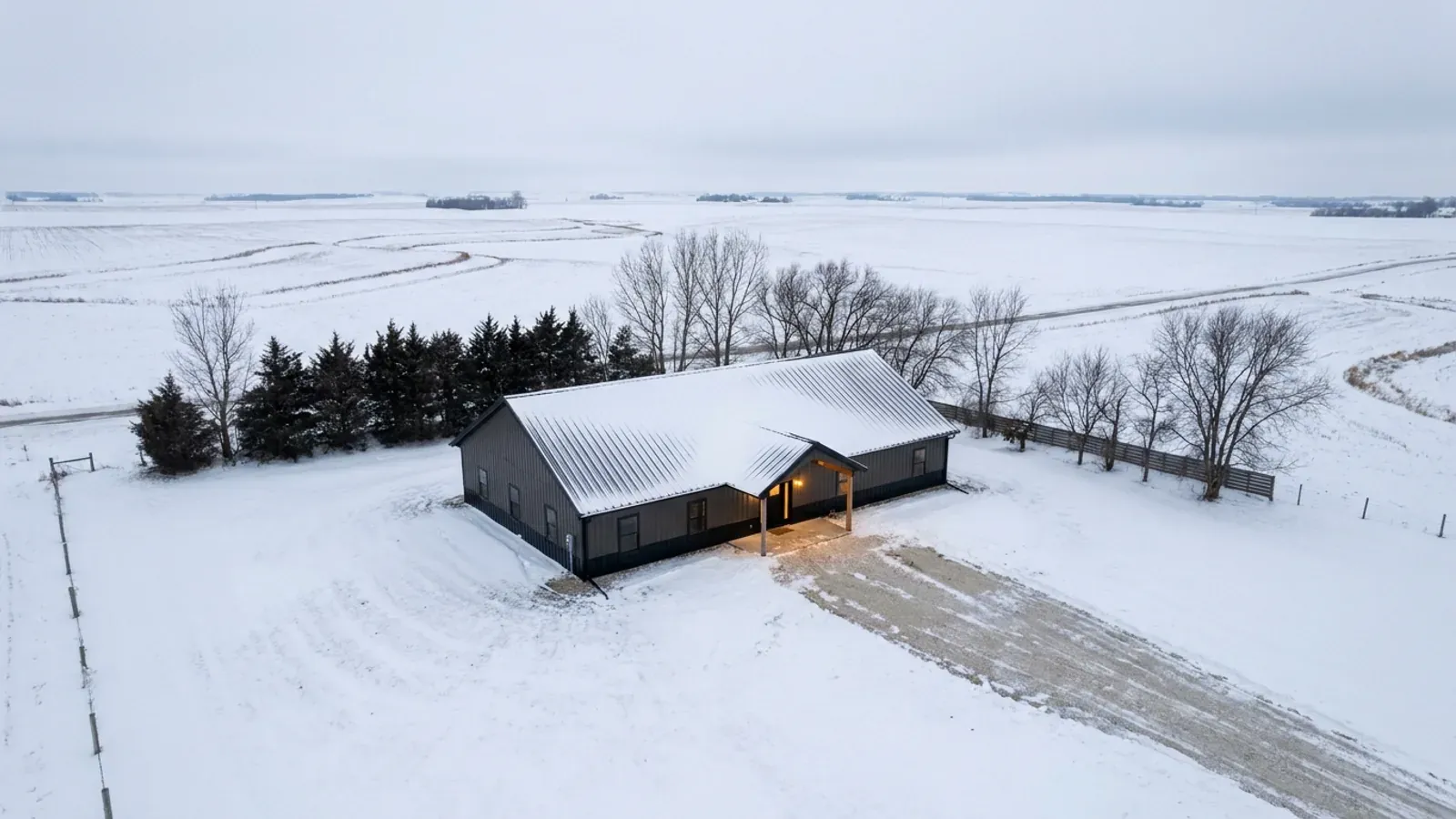
Small Barndominium Floor Plans in Iowa
A small barndominium — roughly 800 to 1,500 square feet of living space, often with a shop bay alongside — is the most common first build on an Iowa acreage: a place to live now, with the big house or the big shop later. Small makes the structure simpler. It does not make the rules go away. A small site-built home meets the same statewide energy code, the same septic minimums and the same local zoning as a large one, and it is regulated very differently from a factory-built tiny home.
What actually changes with this feature
The look is the easy part. These are the decisions that follow from it.
The energy code has no small-house exemption
Iowa's residential energy code applies to new one- and two-family homes throughout the state regardless of size. In both of Iowa's climate zones the state's table sets R-49 ceilings, R-20 cavity walls or R-13 plus R-5 continuous, windows at U-0.32 and an air-leakage limit of four air changes per hour at 50 pascals; slab-edge insulation goes two feet deep in climate zone 5 and four in zone 6. A small building has proportionally more wall and roof per square foot of floor, so the envelope matters more, not less.
How small a dwelling is allowed to be
Iowa sets no statewide minimum house size. Minimum dwelling floor areas and widths, where they exist, are local zoning rules, and they vary by district — an agricultural district may allow what a residential subdivision forbids. Check the zoning ordinance for the specific parcel, not the county in general, before settling on a very small living area.
The floor area where a permit starts is tiny
Permit-exempt thresholds for small buildings are set locally and are far below any habitable size. Unincorporated Scott County exempts one-story detached accessory structures only up to 120 square feet; the IRC's model figure is 200. A small barndominium used as a home is never under either. In a county with no building code, zoning and septic permits still apply.
The septic tank does not shrink with the house
Iowa's private sewage rule sizes systems by bedrooms: 150 gallons per bedroom per day for the absorption area, and under the rewritten chapter 69 a minimum 1,250-gallon septic tank for any home up to and including three bedrooms. A one-bedroom small barndominium therefore buys the same tank as a three-bedroom house, though a smaller absorption field. On a small budget that fixed cost is a large share of the total.
A small barndominium is a site-built house, and Iowa regulates it as one
Iowa treats factory-built structures — manufactured and modular homes — under a separate statewide regime: a unit approved by the state building code commissioner and built to the state's factory-built rules is deemed to comply with building regulations for its manufacture and installation. A small barndominium is not that. It is framed, sheathed and finished on your land, so it meets whatever building code your city or county has adopted, and where the county has none, it still meets the residential energy code the state applies to every new one- and two-family home. That is a feature, not a burden: it means a small barndominium can be financed and resold as a conventional house, and it is why a "tiny home" listing and a small barndominium plan are not interchangeable even when the floor area matches.
Common ways to build this
Common configurations. Yours does not have to match one exactly — this is a starting point for the conversation, not a catalog.
One-room shop-house
900 sq ft living / 600 sq ft shop under one roof
A 30x50 or similar under a single roof: a one-bedroom or open-plan living end and a shop bay separated by a rated garage wall. It is the lowest-cost way to get a legal home and a heated workspace on an acreage in one permit. Put the shop on the north end and it shelters the living space from the winter wind.
Small house with a large detached shop
1,200 sq ft living / 2,400 sq ft detached shop
The acreage pattern where the shop matters more than the house. A compact two-bedroom home sized to live in, beside a machine shed or shop built to working size. On a genuine working farm, Iowa law keeps county zoning and any county building code off farm buildings used for agriculture — the county decides whether yours qualifies — while the house itself is judged on its own facts.
Starter home to be joined later
1,000 sq ft now / planned addition on one gable end
A small first phase designed to be extended: the gable wall that will open to the addition is framed for it, the septic system is sized for the final bedroom count, and the electrical service is sized for the whole house. It costs a little more now and a lot less later, because the expensive decisions are made once.
Ways to build this
This can go together several ways. These are the service lines most relevant to it.
Post-Frame Homes
Post frame and pole barn homes in Iowa, built as real dwellings: frost-depth posts, a designed wall assembly, and a straight answer on the farm exemption.
Read moreBarndominium Kits
Barndominium kits for Iowa land: steel or post-frame shell packages drawn to the design criteria your own county or city publishes, delivered to your site.
Read moreCustom Plans
Custom barndominium floor plans drawn for your Iowa parcel: slab or basement, septic sized to bedroom count, design values from your own jurisdiction.
Read moreSmall Barndominium: common questions
6 common questions about this layout in Iowa. If yours is not on the list, ask it directly.
How small can a barndominium legally be in Iowa?
Is a small barndominium the same as a tiny home?
Can I build the shop first and live in it while I build the house?
Is a small barndominium cheaper per square foot?
Does a small building still need engineered drawings?
Will a small plan still handle an Iowa winter?
Want this drawn for your program and your parcel? That is where a build actually starts.
Start your plans
Tell us what you want to build and we will draw this for your program, then confirm what it looks like on your parcel and the frost depth, snow and wind loads your city or county publishes. That conversation costs nothing.