Barndominium Site Preparation in Iowa
Most of what goes wrong on a barndominium goes wrong below the slab. Site preparation is clearing, cut and fill, a compacted pad, drainage, the driveway and culvert, and getting power, water and wastewater to the building. On Iowa land it starts with the soil, because the soil decides two things at once: the foundation, and whether the parcel will take a conventional septic field. Iowa's onsite wastewater rule requires a percolation test or professional soil analysis before any soil absorption system is installed, and a conventional field only where the soil percolates at between 1 and 60 minutes per inch. That answer belongs before the pad is set, not after.
Site Preparation: how the work runs
Four stages, in this order. The sequence matters more than it looks: getting the design values, the septic answer and any permits settled before anything is fabricated is what keeps an Iowa build from stalling.
Boundary, topography and legal access
Before any dirt moves, three things are settled on paper: where the lines are, how the ground falls, and how you get onto the parcel legally. A licensed land surveyor locates the corners where they are not already clear. The entrance comes from whoever owns the road — the county for a secondary road, the state for a state highway, the city inside city limits — and each has its own permit. Nothing is scheduled until the access answer is in hand.
Soil and the septic site evaluation
The county board of health evaluates the site before it issues a septic construction permit, looking at slope, floodplains, property lines, buried utilities, wells and existing or proposed drainage tile. The soil is tested by percolation test or professional soil analysis, with a six-foot hole to find any confining layer. A conventional field needs a rate between 1 and 60 minutes per inch; slower soil can still take a mound system below 120 minutes per inch. This step decides whether the house you have drawn fits the land, and it is worth doing before the land is bought.
Pad, drainage and frost
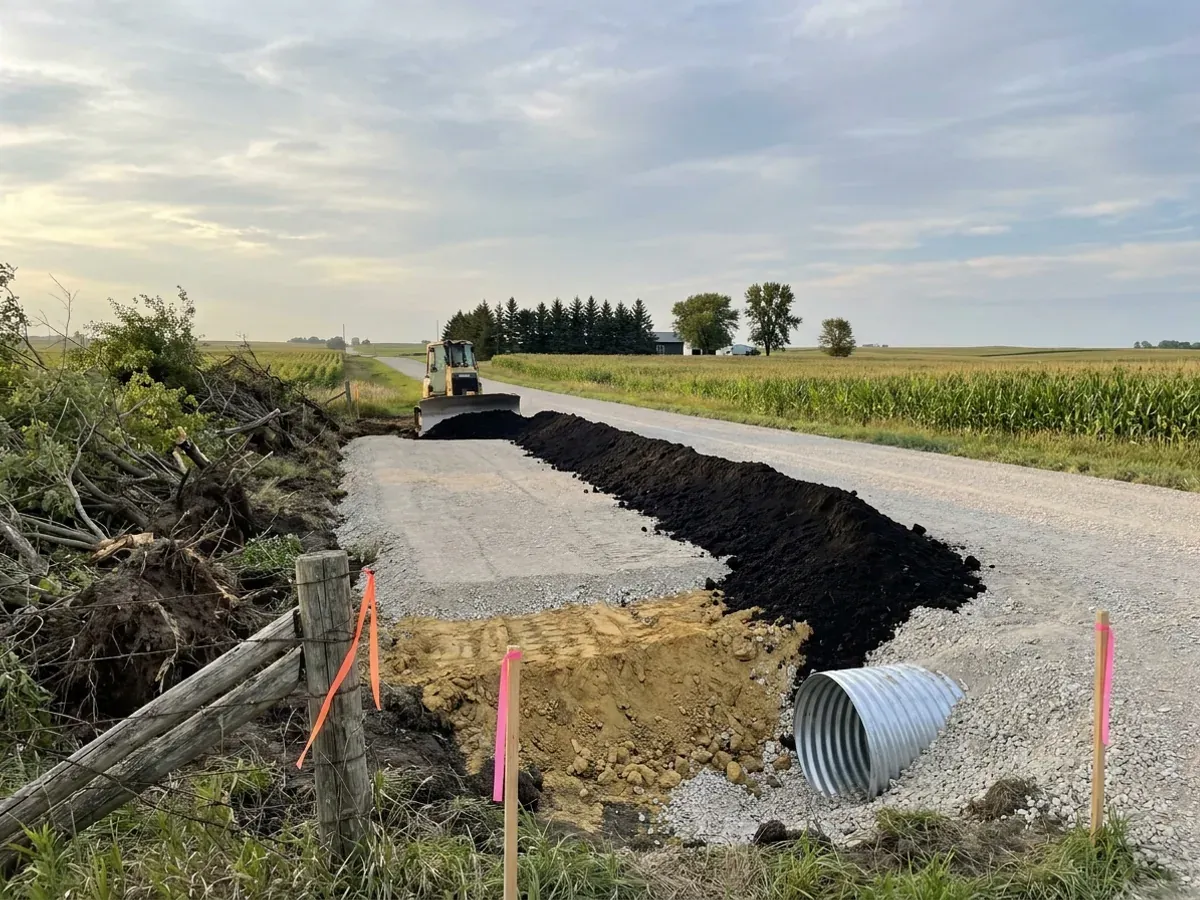
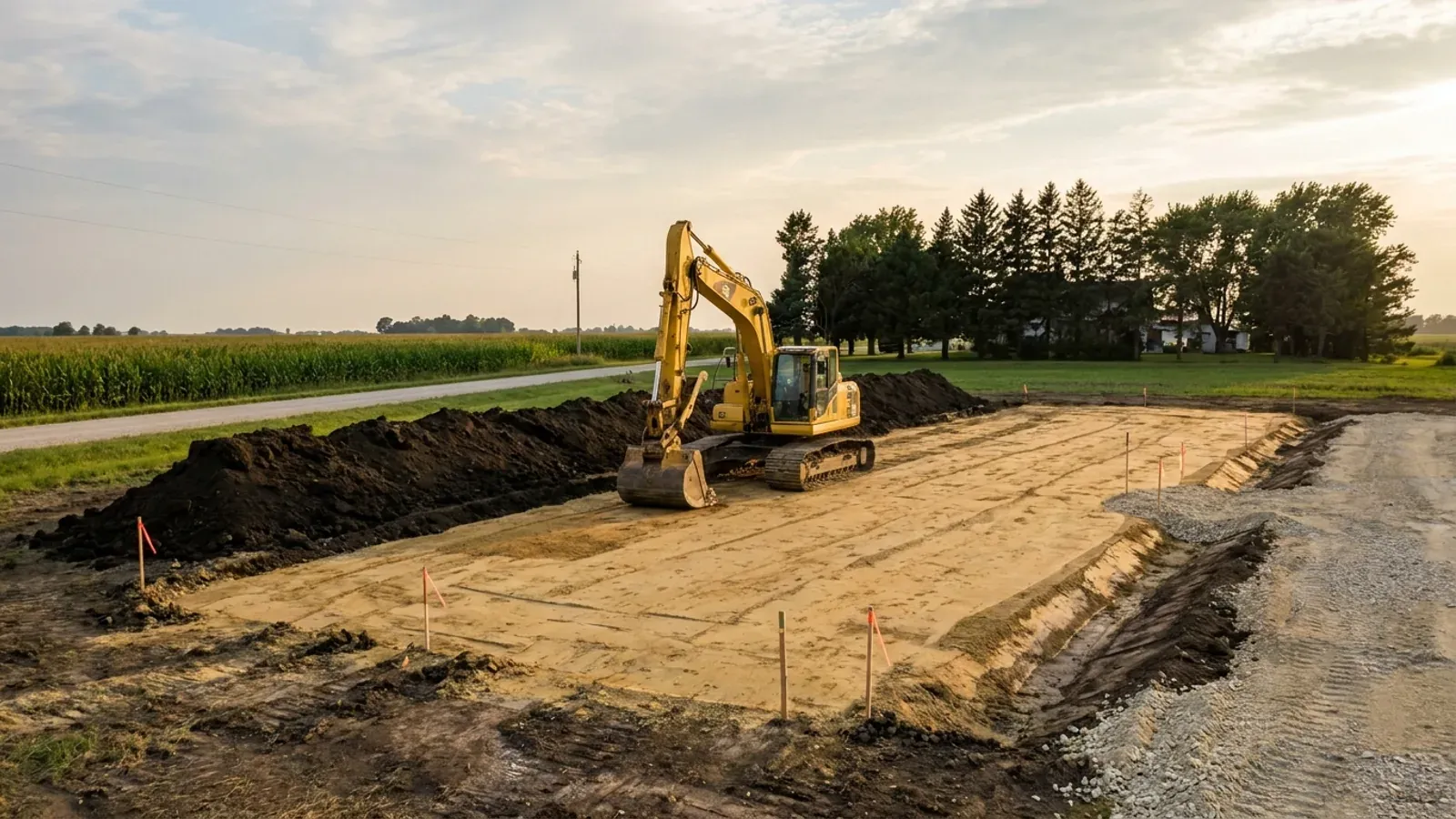
Topsoil is stripped and stockpiled, the pad is cut and filled to design elevation, and fill is compacted in lifts and tested. Footings go below the frost line your jurisdiction publishes — Des Moines, Cedar Rapids, Polk County and Scott County each publish 42 inches. The pad is graded so water leaves the building, and drainage tile is located and either protected or rerouted, because cutting a field tile line under a building site can leave water with nowhere to go.
Well, septic and utilities to the pad
A new private well needs a well construction permit before drilling, from the Iowa DNR or a county authorised to issue it, and it is drilled by a certified well contractor. The septic system is installed to its permit and inspected by the county on location before it is backfilled. Nothing may be built over the tank or the field — driveways included — and roof and storm drains must stay off it, so the driveway, pad and downspouts are laid out around it. Power comes last, run to a service location the utility has approved.
Iowa land is valued for what it grows; a house site is judged on what it drains
Iowa State University's 2025 Land Value Survey put the statewide average at $11,549 an acre as of 1 November 2025, from $7,623 in South Central Iowa to $14,522 in the Northwest district. Those figures price farmland for crops. A barndominium site is judged differently: a spot above the floodplain, soil that will take a septic field, room for the well setbacks, and a way in that does not cross a wet swale. The cheapest acre on the parcel is often the one that costs most to build on, which is why we walk the land before the house is sited.
Where we deliver site preparation
In Iowa the line that matters is often a city limit rather than a county line. Inside a city you usually have city zoning and a city building department; within two miles of one, its zoning can reach out to you; out in the county, some counties enforce a building code and many rural ones do not. Cross one of those lines and what changes is whether the build is inspected, who reviews the drawings, how the land is zoned, and whose snow, wind and frost values the drawings answer to. The septic permit from the county board of health and the state energy code go with you everywhere.
Barndominium builders across Iowa.
Every city and county we build in has its own answer on permits, septic and design values. The service area pages set out what each one publishes.
What actually decides the price
Square footage is the number everyone leads with, and it is rarely the one that moves a barndominium budget. These four do.
-
Soil and the septic system it allows
Soil that percolates within Iowa's conventional range takes a gravity or pressure field; slower soil needs a mound or another engineered system, which costs considerably more. The soil test is cheap relative to the difference, which is why it comes first.
-
Cut, fill and haul
A level site needs little more than topsoil stripping and a compacted pad. A sloped site, or a building set on fill to get it above wet ground, can need a lot of material brought in and compacted in lifts. Imported fill is one of the least predictable lines in site work.
-
Driveway length and culverts
A long lane on a rural parcel needs a rock base that will carry a concrete truck in spring, culverts where it crosses a ditch or swale, and an entrance permit from the road authority. Length and ground conditions move this number more than anything else.
-
Distance to power
How far the service has to run from the nearest line, and whether it goes overhead or underground, can be a significant cost on a set-back building site. Ask the utility for a line-extension estimate early; its policy decides who pays for what.
Site Preparation in Iowa: common questions
8 questions we get asked most often about building in Iowa. If yours is not on the list, ask it directly.
What should I check before buying land for a barndominium in Iowa?
Do I need a septic permit in Iowa?
What happens if my land fails the perc test?
Do I need a permit to drill a well in Iowa?
How deep do footings go in Iowa?
What about field tile on my land?
Can I build in a floodplain?
When is the best time of year to do site work in Iowa?
Keep reading
The pages that answer the next question this one raises.
How Long Does It Take?
Where site work sits in the schedule, including the septic permit and freeze-up.
Read itBarndominium Cost Guide
Site work is the largest wildcard on any rural build. Here is why.
Read itWhere We Build
Who handles septic, wells and permits in each Iowa city and county we serve.
Read itReady to put site preparation against a real plan? Start there and the rest follows.
Tell us about the land
Tell us where the parcel is and what you want on it, and we will come back with who has jurisdiction, what the land needs before it can be built on, and a realistic budget range. Starting the survey costs nothing.