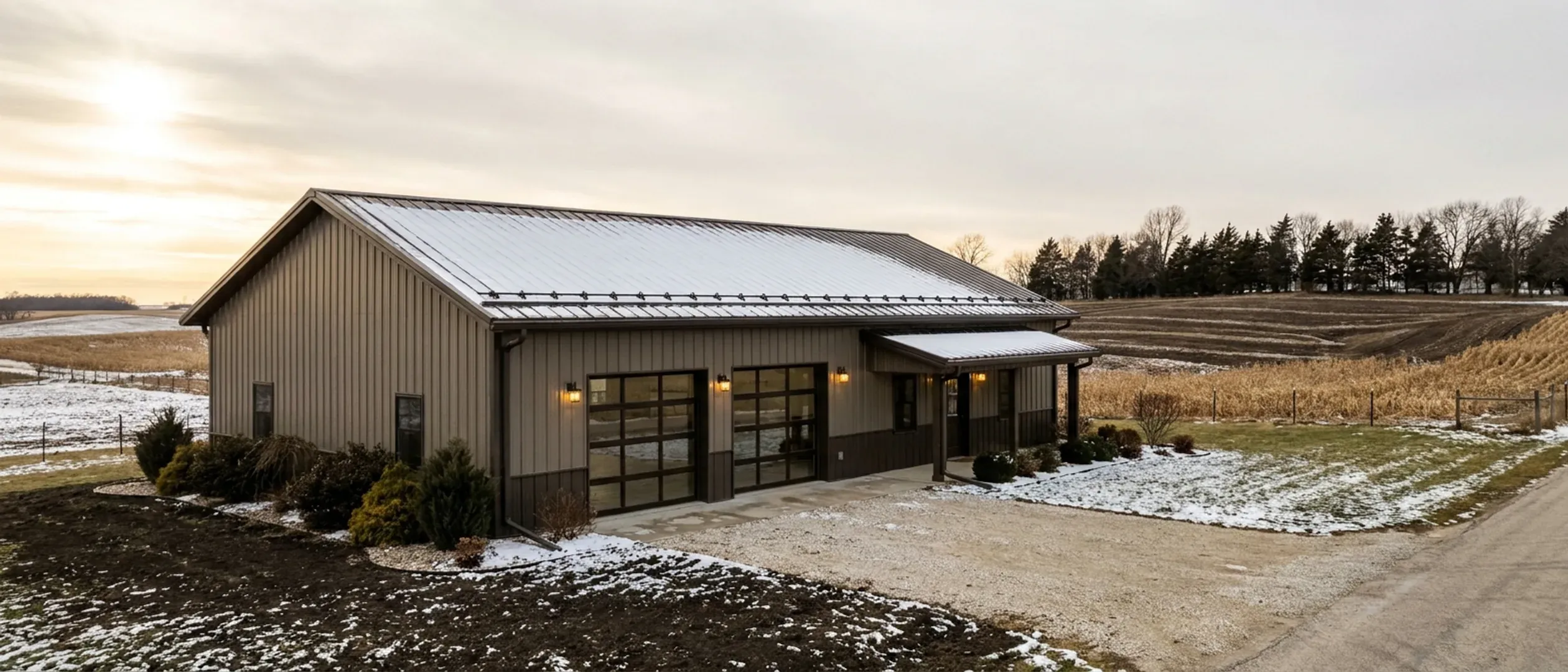
Barndominium Build Timeline in Iowa: Permits, Frost and Spring Road Embargoes
Most timeline pages attach week counts to a list of stages and call it a schedule. This one starts from the things an Iowa build actually waits on, because those are checkable: the review time a county prints on its own permit page, the septic permit that some counties require before they will issue a building permit, the Iowa Code section that lets a county close its gravel roads to heavy trucks for up to ninety days a year, and the ground that is frozen for part of every winter. The gaps between those fixed points are where a realistic schedule lives. Two cautions first. Iowa has no single permit process — in a city or a county with a building department there is plan review and inspection, and on many rural parcels there is no building permit at all — so the permitting half of the calendar varies more between parcels than anything else. And the review times quoted below are examples of what real published numbers look like in three Iowa counties, not a statewide range.
Figures on this page are cited third-party or government data, not a quote from Iowa Barndominium Builders.
Bottom Line Up Front
- The shell is fast and the interior is not. Once the pad or foundation is ready, a post-frame or steel shell goes up and dries in quickly; the insulation, mechanicals, drywall and finishes of the living quarters take most of the remaining calendar.
- In Iowa the front end is paperwork and ground. Septic approval from the county board of health, a driveway entrance permit and, where one exists, the building permit come first — Dallas County will not issue a dwelling permit without the septic permit and any required entrance permit already in hand.
- Winter and spring set hard limits. Footings and post holes cannot be dug or poured properly in frozen ground, and under Iowa Code § 321.471 counties can restrict heavy vehicles on roads damaged by thaw for up to ninety days a year — which can keep concrete, steel and truss deliveries off a gravel road just as the ground opens up.
Published Iowa permit review times — and why these three are not a range
Three counties print their own review times for a new house. They describe different processes, and a review clock only starts when the application is complete.
Polk County: allow 5–7 business days
Polk County Public Works' single-family home permit checklist asks applicants to allow 5–7 business days for permit review and approval. The same checklist lists the septic or sewer, well and entrance items that must be reviewed and paid before the permit is issued, and states that construction work cannot begin until the building permit has been issued.
Dallas County: up to 10 business days, after everything else is in
Dallas County's permit page says review can take up to 10 business days once the listed items have been received, that applications are processed in the order received, and that incomplete applications are returned. For a dwelling, the list includes a scaled site plan, a complete set of construction plans, the septic permit from Environmental Health, an approved entrance permit where one is needed, and issued electrical, mechanical and plumbing sub-permits. A new home needs two electrical permits, one for temporary power and one for the new service.
Scott County: usually 3–5 days for a house
Scott County's Planning and Development page says that in most cases review of the building and site plans can be completed in 3–5 days, with commercial construction taking seven to ten. Scott County charges a $100 plan review fee when plans for a new house are submitted, deducted from the building permit fee.
What the three have in common
The published clock is short; the preparation before it is not. Each county wants the septic or sewer arrangement, the driveway entrance and a complete plan set before the review even starts. The weeks go into soil testing, the septic design, stamped structural drawings for the building package and the entrance permit — so start those first.
The stages, in the order Iowa makes you do them
No week counts here, because they depend on your jurisdiction, your season and your building package. What is fixed is the order.
1. Parcel due diligence
Zoning district and setbacks, whether a dwelling is allowed, who issues building permits, whether public water or sewer is available, the flood zone, and whether the access road is gravel. Do this before you close on land.
2. Soil testing and septic permit
Percolation test or soil analysis and site evaluation by the county, septic design sized on bedrooms, construction permit. Unfrozen ground needed.
3. Plans and the building package
Floor plan, structural drawings for the post-frame or steel package — commonly stamped by an Iowa-licensed professional engineer where a building department reviews them — and energy-code documentation, since the residential energy code in 481 IAC 301.24 applies to new homes statewide.
4. Entrance permit, address and building permit
Driveway entrance from the county or, on a state highway, from the Iowa DOT; address assignment; then the building permit where one exists. Dallas County, for example, needs a scaled site plan and an approved entrance permit before it will assign an address.
5. Site work and foundation
Pad, drainage and the driveway, then footings, piers or post holes and the slab. This is the stage frost and road embargoes govern. The notice of commencement goes to the lien registry within ten days of starting.
6. Shell erection and dry-in
Posts or columns, trusses or rafters, girts and purlins, roof and wall sheeting, doors and windows. Fast once materials are on site; wind and deep cold slow crane and roof work.
7. Rough-ins and inspections
Interior framing of the living quarters, then plumbing, HVAC and electrical rough-in. Electrical work for a new service is inspected under Iowa Code § 103.23 — by the local programme where one exists, otherwise by the state — so book it rather than assume it will happen on its own.
8. Insulation, drywall and finishes
Insulation and air sealing to the energy code, then drywall, flooring, cabinets, fixtures and trim. The longest stage and the least visible progress.
9. Final inspections and occupancy
Where a building department exists, the final inspection and certificate of occupancy; everywhere, the septic final inspection before backfill and the electrical final. Keep every record — a future buyer's lender will ask for them.
Planning around an Iowa year
Season matters more to the front half of the schedule than to the back half.
Late summer and autumn: the best time to start the ground work
Soil tests, septic approval, pad and foundation while the ground is workable, aiming to have the shell closed in before hard freeze so interior trades can work through winter.
Winter: paperwork and interiors
A good time to finish plans, order the building package and run permit applications. Interior work continues in a closed, heated shell; new excavation and septic installation generally wait.
Spring thaw: the embargo window
Thawing gravel roads are at their weakest. Scott County's secondary roads page points readers to an educational video from Iowa's county engineers on the effect of the spring thaw on Iowa's more than 66,000 miles of gravel roads. Heavy deliveries may need a county permit or may have to wait until restrictions lift.
Late spring and summer: peak season for trades
Ground is open and roads are unrestricted, and every other builder in the county wants the same concrete crews, excavators and inspectors. Booking early matters more than in any other season.
What most often stretches an Iowa schedule
These are the recurring causes of delay, in roughly the order they appear.
A poor percolation result
Slow-draining soils can require a different system type, a larger area or a redesign, and the house may have to move on the lot to make room.
Incomplete applications
Counties that publish review times also say the clock starts only with a complete package. Missing structural stamps, a site plan without setbacks drawn to the right-of-way, or an absent septic permit send the file back.
Weather at the wrong moment
An early freeze before footings are poured, or a long thaw that keeps an embargo in place, can move a start by months.
Material lead times
Engineered trusses, steel packages, windows and doors all have lead times that the supplier, not the builder, controls. Order against a confirmed site date.
Changes after framing starts
Moving walls, adding a bedroom or relocating a bathroom after rough-in means redoing work and sometimes the septic design, and in a permitted jurisdiction a plan revision.
Reading this because you are weighing a build? The next step is a plan drawn for your program.
What's different about Iowa
Who issues the permit decides the length of the front end
Under Iowa Code § 103A.10 the State Building Code applies only where a city or county has adopted it, or in a city of more than fifteen thousand people without a comparable code of its own, and § 103A.19 leaves permits and inspections to local ordinance. So there are three different front ends in Iowa. Inside most cities, and in counties with a building department such as Polk, Linn, Johnson, Scott and Pottawattamie, there is plan review, a building permit and a sequence of inspections. In counties with zoning but no building code there may be a zoning or land-use permit and no structural review. And in some rural places there is neither. Establish which one your parcel is in before you draw a calendar, because the difference is weeks.
The septic permit is often the first gate, not a late detail
Iowa Code § 455B.172 puts private sewage disposal under the county board of health, and 567 IAC 69.1(4) requires a construction permit before a system is installed. Under 69.1(6) the permit follows a site evaluation and a percolation test or soil analysis, and the system is inspected before it is backfilled. That puts soil testing near the very start of the job — and in counties that tie the building permit to it, nothing structural can be permitted until it is done. A percolation test needs workable, unfrozen ground, so a parcel bought in December may not be testable until spring.
Frozen ground and winter concrete
Every Iowa winter freezes the ground to a depth your jurisdiction publishes in its design table — 481 IAC 301.8(3) leaves those values to the location of the project, so there is no single Iowa number. Footings and post holes go below that depth, and they cannot be excavated cleanly or poured onto frozen soil. Concrete can be placed in cold weather with heated enclosures, blankets and accelerating admixtures, but each adds cost and each still needs thawed subgrade. Most Iowa builds that start foundations in late autumn either pour before the ground freezes or wait for spring; a shell that is closed in before winter lets interior work continue through it.
Spring weight embargoes on county roads
Iowa Code § 321.471 allows a local authority to prohibit vehicles or restrict their weight on a road under its jurisdiction for a total of not more than ninety days in any calendar year whenever deterioration, rain, snow or other climatic conditions would otherwise seriously damage it, and § 321.472 makes the restriction effective only once signs are posted at each end of the affected section. Linn County publishes how it uses that power: during its embargo it limits gross vehicle weight to 5 tons on rock roads and 10 tons on hard-surfaced roads, and it issues an embargo permit for eight weeks, for which Linn County charges a $50 fee, to haulers who provide proof of insurance and accept responsibility for road damage. A loaded ready-mix truck, a truss delivery or a steel package is well above those limits. If your site is on a gravel road, ask the county engineer's office when it usually posts and lifts its embargo, and plan foundation pours and deliveries around it.
Permits have clocks too
Polk County's single-family permit checklist states that work must commence within 180 days of the permit issuance date and be completed and inspected within one year, or the permit is null and void. Other building departments set their own terms. A build that stalls over a winter can lose its permit rather than just its momentum, so if a start is likely to slip past a deadline, ask about an extension before it lapses.
The lien-registry notice is a ten-day step at the start
Iowa Code § 572.13A requires the general contractor, or an owner-builder who hires subcontractors, to post a notice of commencement of work to the Mechanics' Notice and Lien Registry no later than ten days after work begins. It takes minutes, but it belongs on the calendar: subcontractors and suppliers post their preliminary notices against it, and the owner notice the registry sends explains why you should check the registry and collect lien waivers before each payment.
Pros and cons, honestly
Pros
- The shell is genuinely fast. Once the pad or foundation is ready and the package is on site, a post-frame or steel structure goes up and dries in quickly.
- A closed-in shell lets interior work carry on through an Iowa winter.
- Where no building department exists, there is no plan-review wait on the structure.
- Iowa counties that run building departments publish their review times and requirements, so the front end can be planned from real numbers.
- Clear-span framing leaves fewer structural interior walls to build before mechanical rough-ins can begin.
Cons
- The interior of the living quarters is most of the calendar and little of the visible progress.
- Soil testing and septic approval need unfrozen ground, which can hold up a winter land purchase until spring.
- Spring weight embargoes on gravel roads can keep concrete and material deliveries away just as the ground becomes workable.
- Permits can expire — Polk County's checklist voids a permit if work is not started within 180 days or finished and inspected within one year.
- Peak-season demand for excavators, concrete crews and inspectors lengthens every step from late spring onward.
- Stamped structural drawings, septic design and entrance permits must all be ready before a county's published review clock even starts.
How long does it take to build a barndominium in Iowa?
How long does an Iowa county take to review a house permit?
Can you pour a barndominium foundation in an Iowa winter?
What is a spring road embargo and why does it matter?
Do I need the septic permit before the building permit?
Is a barndominium faster to build than a conventional house?
When should I start if I want to move in next year?
Does a building permit expire in Iowa?
Questions answered? Tell us what you want to build and we will put real numbers against it.
Sources
- Iowa Code § 321.471 — local authorities may restrict vehicle weights (up to 90 days a year)
- Iowa Code § 321.472 — restriction signs must be posted
- Linn County, Iowa — Road Closures & Restrictions (road embargoes and embargo permit)
- Scott County, Iowa — Spring Thaw on Gravel Roads
- Polk County Public Works — Single Family Home Building Permit Application and Checklist
- Dallas County, Iowa — Building Permit Application Process
- Scott County, Iowa — Building Permit Applications
- Iowa Code chapter 103A — State Building Code (§§ 103A.10, 103A.19)
- 481 IAC chapter 301 — State Building Code, including 301.8(3) design values and 301.24 energy code
- 567 IAC chapter 69 — private sewage disposal systems
- Iowa Code § 572.13A — notice of commencement of work
- Iowa Code chapter 103 — electrical inspection (§ 103.23)
Keep reading
The pages that answer the next question this one raises.
Are barndominiums legal in Iowa?
Which codes and permits reach your parcel — the rules that decide the front end of this schedule.
Read itSite preparation
Pad, drainage, septic placement and the driveway entrance, sequenced around the season.
Read itPermitting help
Assembling a complete application so a county's review clock starts on the first submission.
Read itTurnkey builds
One team managing every stage on this page, from soil test to final inspection.
Read itStart with your land
Tell us where and when you want to build, and we will map the steps your parcel needs.
Read itWant a real number instead of a range?
Start the survey and tell us about your land and what you want to build. Include the county and parcel ID if you have them, because in Iowa the jurisdiction, the soil and the well and septic answers change the budget more than the building does. The survey costs nothing.