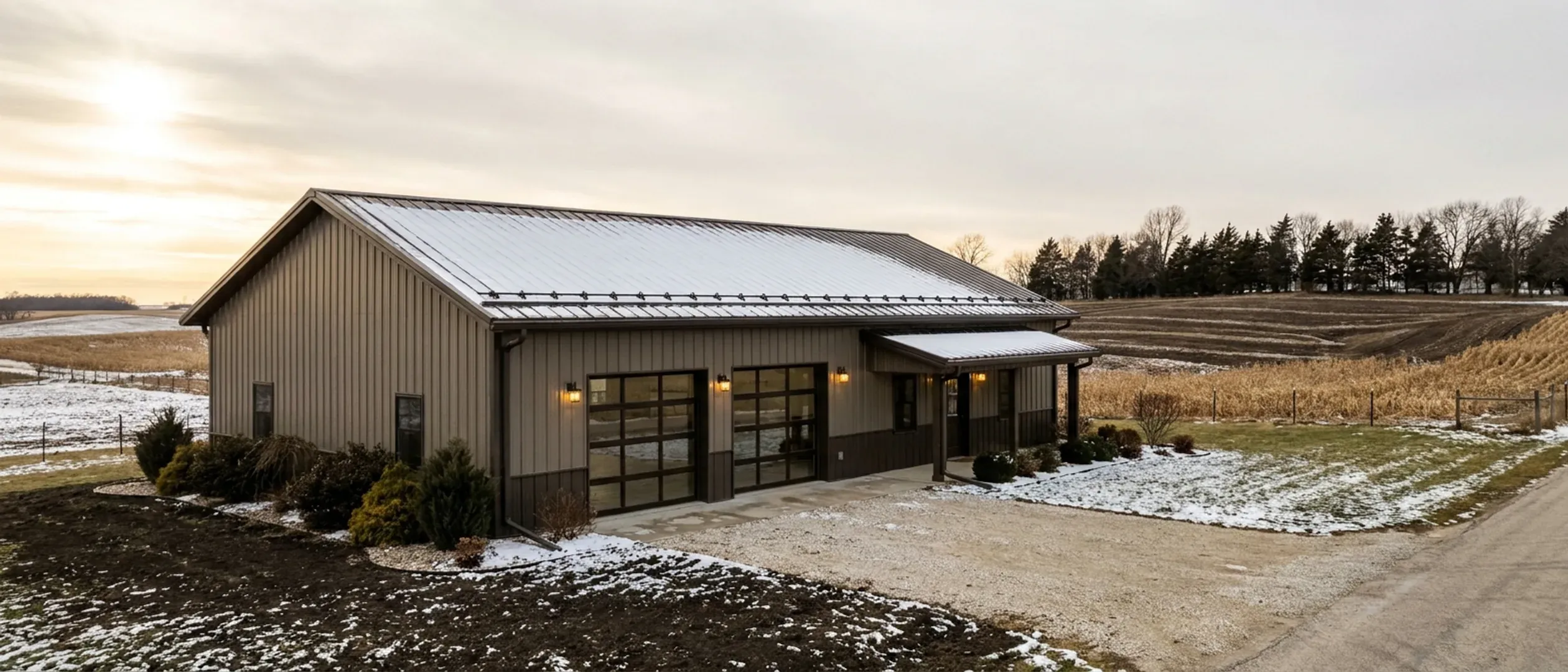
Are Barndominiums Legal in Iowa? Building Codes, Zoning and the Farm-House Exemption
Nothing in Iowa law singles out a barndominium. A post-frame or steel-framed house is a house, and it is regulated by whatever rules reach the parcel it stands on. The difficulty is that in Iowa those rules come in layers with different reach. The State Building Code applies only where a city or county has accepted it, so on many rural parcels there is no building permit and no framing inspection at all. But several rules apply everywhere regardless: the residential energy code, state electrical inspection of a new service, the county board of health's septic and well permits, and contractor registration. On top of that sits the agricultural exemption from county zoning, which a genuine farm house can claim and a house with a hobby-scale farm usually cannot. This guide works through each layer from the Iowa Code and the Iowa Administrative Code, so you can tell which ones reach your land before you buy it or draw a plan.
Figures on this page are cited third-party or government data, not a quote from Iowa Barndominium Builders.
Bottom Line Up Front
- A barndominium is legal anywhere in Iowa that a house is legal. The questions that matter are zoning (can a dwelling go on this parcel) and which codes reach it — and the answers are set by your city or county, not by the building type.
- The State Building Code, currently the 2024 International Residential Code under 481 IAC 301.8, applies only where a city or county has adopted it, or in a city over 15,000 people with no comparable code of its own (Iowa Code § 103A.10). Outside those places there may be no building permit at all.
- Four things reach every new Iowa home even where there is no building code: the residential energy code (2012 IECC, Iowa Code § 103A.10(4) and 481 IAC 301.24), state electrical inspection of new service equipment (§ 103.23), a septic construction permit from the county board of health (567 IAC 69.1(4)), and a well construction permit (567 IAC 49.3(3)).
Zoning: can a house go on this parcel at all?
Zoning is the first gate, and it is a different question from the building code. In unincorporated Iowa it is set by county zoning under Iowa Code chapter 335, inside a city by city zoning under chapter 414, and within two miles of some cities by the city's extended zoning.
Iowa Code § 335.2 exempts farm houses from county zoning — while so used
No county zoning ordinance applies to land, farm houses, farm barns, farm outbuildings or other buildings or structures that are primarily adapted, by reason of nature and area, for use for agricultural purposes, while so used. The same section keeps floodplain regulation in force for any structure or excavation in or on the floodplain of a river or stream, farm or not. The exemption applies only outside city limits, because county zoning under § 335.3 reaches only land outside the corporate limits of any city.
A house on farmland is not automatically a farm house
In Lang v. Linn County Board of Adjustment (Iowa Supreme Court, No. 11–0683, filed 29 March 2013) the court upheld Linn County's refusal to treat two houses as exempt farm houses — the owners' own home once it had been split onto a 6.52-acre parcel, and a second house on a 43.3-acre property with a tree farm, fish pond and conservation acreage. It held the county was entitled to look at the relative size, value and construction date of the house compared to the scope, value and duration of the claimed agricultural activities, and said the legislature did not intend a homeowner to avoid county zoning simply by having a tomato patch in the backyard. The court also said farm income need not provide most of the household's money, and that there can be more than one exempt farmhouse on a property. For a barndominium the lesson is plain: a large new home on an acreage with a modest farming sideline is the fact pattern Lang rejected.
The 2020 amendment left farm houses out of the no-application rule
Since 2020, § 335.2(2) says a county shall not require an application, an approval or a fee for an ordinance to be deemed inapplicable to land, farm barns, farm outbuildings or other agricultural structures. Farm houses appear in subsections 1 and 3 of the section but are absent from that list. Our reading of the text — not a court ruling — is that a county may still ask you to apply for a farm-house determination. A shop or barn used for farming is a different matter: the county cannot make you apply for that.
City fringe zoning carries the same exemption
Iowa Code § 414.23 lets a city extend its zoning up to two miles beyond its limits where the county has no zoning ordinance, and states that the § 335.2 agricultural exemption applies in that extended area. Inside city limits there is no general farm exemption.
What zoning usually decides for a barndominium
Whether a dwelling is a permitted use in the district; minimum lot size and frontage; setbacks from property lines and road right-of-way; whether a large accessory building may be built before, or without, a house; and whether a home business can run from the shop. None of these depend on the building being post-frame or steel. Read the district text for your parcel before you buy it, not after.
The rules that reach every new Iowa home
These apply whether or not your city or county has a building department. Plan for them on every parcel.
Residential energy code — statewide
The 2012 IECC residential provisions as amended by Iowa, adopted by 481 IAC 301.24 under Iowa Code §§ 103A.8A and 103A.10(4). The rule excludes remodeling of existing one- and two-family dwellings, not new ones.
Electrical inspection of a new service — by the state where no local programme exists
Iowa Code § 103.23(3) makes the inspection provisions of the electrical chapter apply to all new electrical installations for single-family residential applications requiring new electrical service equipment. Under § 103.24(2) state inspection is displaced only where a city or county runs its own qualifying electrical inspection programme. So in a county with no building department, the electrical work on a new barndominium is still inspected — by the state. Under § 103.25 the licensee or property owner making the installation requests the inspection at or before commencement. Anyone wiring for another person must hold an Iowa electrical licence under § 103.11. The owner-occupant exemption in § 103.22(7) is written for an existing dwelling rather than new construction, so do not assume it covers wiring your own new house.
The farm electrical exception is narrow
Under § 103.22(15) a person associated with a farm — an owner, relative, employee, operator or manager — needs no licence for an installation on a farm, and no permit or inspection is required. Under § 103.29(7) a county shall not perform electrical inspections on a farm or farm residence. § 103.1 defines a farm as land, buildings and structures used for agricultural purposes. Whether a barndominium qualifies turns on real agricultural use, the same way the zoning exemption does.
Septic system construction permit — the county board of health
Iowa Code § 455B.172 makes each county board of health responsible for regulating private sewage disposal and private water supplies in its jurisdiction, at standards at least as stringent as the state's. Under 567 IAC 69.1(4) no private sewage disposal system may be installed or altered without a construction permit issued before construction. Under 69.1(6) the administrative authority conducts a site evaluation before issuing the permit, soil suitability is established by a percolation test or a soil analysis, and the authority inspects the new system before it is backfilled. Residential systems are sized on bedrooms, so the shop floor area does not enlarge the system, but a bonus room that could be called a bedroom may. One caution: chapter 69 was rewritten in 2025 and the Administrative Rules Review Committee delayed the rewrite's effective date, so ask the county sanitarian which version of the chapter it is applying to your permit.
Private well construction permit
Under 567 IAC 49.3(3) a landowner shall not construct a new private well without first obtaining a well construction permit from the Department of Natural Resources or a county authorised to issue permits, and under 49.6(3) the permit requires the well to be built by a certified well contractor.
Contractor registration and the lien registry
A contractor building for you must be registered under Iowa Code chapter 91C. Iowa Code § 572.13A then requires the general contractor — or an owner-builder who hires subcontractors — to post a notice of commencement of work to the State's Mechanics' Notice and Lien Registry no later than ten days after work starts. The notice the registry sends the owner warns that suppliers and subcontractors may enforce a lien even if you have paid the general contractor, and advises checking the registry and collecting lien waivers before each payment.
Where a building department does exist
If your city or county has adopted a building code, the barndominium goes through the same plan review and inspections as any house. A few Iowa-specific points are worth knowing.
Post-frame drawings are usually engineered
Building departments commonly require stamped structural drawings for post-frame buildings. Dallas County, for example, states on its permit page that all post frame construction must have stamped or engineered plans, including the trusses. Budget for an Iowa-licensed professional engineer to stamp the post, truss and bracing design supplied with a kit or package.
The state code does not require residential sprinklers
481 IAC 301.8 deletes the IRC's fire sprinkler requirement for new one- and two-family dwellings and townhouses, consistent with a 2010 joint resolution of the General Assembly. A city or county running its own code could still require them, so check the local adoption.
Plumbing is governed statewide but inspected locally, if at all
Iowa Code § 105.4 makes the state plumbing code and state mechanical code applicable in each local jurisdiction, and states that local jurisdictions are not required to conduct inspections under them. Plumbing work done for you must be done by a licensed plumber, and the owner exemption in § 105.11(3) is written for an existing dwelling rather than new construction, or for farm property.
Permits cannot issue to an unregistered contractor
Iowa Code § 103A.20(1)(b). If your builder cannot give you a current registration number, the permit application stops.
A certificate of occupancy exists only where an ordinance requires one
Iowa Code § 103A.19(2)(d) lets a governmental subdivision issue certificates of occupancy as may be required by ordinance. In a county with no building department there is none to obtain. Keep the septic permit and as-built drawing, the state electrical inspection record, the well permit and your energy-code documentation instead; they are what a future buyer, appraiser or insurer will ask for.
Lenders, appraisers and insurers
None of these are legal gates, but each can stop a build that the law allows.
The appraisal, not the law, is usually the constraint
A construction or permanent loan depends on an appraiser finding comparable sales. In much of rural Iowa there are few recent sales of post-frame or steel homes nearby, so the appraiser may lean on conventional houses and adjust. Bring your plans, specifications and any local barndominium sales you know of to the lender early.
Document the build even where nobody inspects it
Lenders and insurers ask for evidence of code compliance. Where there is no building department, the state electrical inspection, the septic final inspection and a record of energy-code compliance are the documents you can produce. Collect them as the build proceeds rather than reconstructing them later.
Tell the insurer what the building is
Carriers classify post-frame and steel-framed homes differently from one another and from conventional framing, and a shop under the same roof raises questions about what is stored and worked on there. Describe the structure, the shop use and any wood or fuel-burning heat accurately when you get a quote, before the loan closes.
Six questions that settle whether your barndominium is legal where you want it
Answer these in order for a specific parcel. Each is answerable with a phone call or an afternoon on the county's website.
1. Is the parcel inside a city, within two miles of one, or in unincorporated county?
That decides whether city zoning, city fringe zoning or county zoning applies, and whether the § 335.2 farm exemption is even available.
2. Is a dwelling a permitted use in the zoning district?
If the county has no zoning ordinance, the answer may be yes by default; if it does, read the district text, the lot-size minimum and the setbacks.
3. Who, if anyone, issues building permits here?
A city building department, a county building department, or nobody. If someone does, ask which code edition, the published design values, and whether post-frame drawings must be stamped.
4. What does the county sanitarian need for the septic permit?
A percolation test or soil analysis, a site evaluation, and a design for the number of bedrooms. In some counties the building permit will not issue until the septic permit has.
5. Is there public water, or will you drill?
A private well needs a construction permit before drilling and a certified well contractor.
6. Is the home a genuine farm house?
Only if the agriculture is real in scale and duration relative to the house. If you intend to rely on the exemption, ask the county how it decides and whether it wants an application, and get the answer in writing.
Reading this because you are weighing a build? The next step is a plan drawn for your program.
What's different about Iowa
The State Building Code is adopt-where-adopted
Iowa Code § 103A.10(2) lists where the State Building Code applies: to state-owned buildings, to buildings paid for in part with state appropriations, in each governmental subdivision whose governing body has enacted an ordinance accepting the code, and in each city with a population of more than fifteen thousand that has not adopted its own code substantially in accord with a nationally recognized model code. Section 103A.22 leaves every city and county free to adopt its own building regulations instead. The residential part of the state code is the International Residential Code, 2024 edition, adopted by reference in 481 IAC 301.8. The practical consequence is that the answer to 'does Iowa require a building permit for my barndominium' is 'Iowa does not; your city or county might'. Most Iowa cities run a building department. Some counties do — Polk, Linn, Johnson, Scott and Pottawattamie among them — and many rural counties do not. A city or county that wrote its own code may also be on an earlier IRC edition than the state's 2024 text, so ask for the edition in writing.
The energy code has no such limit — it applies statewide
This is the rule most rural owners do not expect. Iowa Code § 103A.10(4)(a) makes the state code's thermal efficiency standards applicable to all construction in the state which will contain enclosed space that is heated or cooled, and § 103A.8A makes energy conservation requirements apply to new single-family and two-family construction commenced on or after July 1, 2008. The rule that implements it, 481 IAC 301.24, adopts the residential provisions of the 2012 International Energy Conservation Code, with Iowa amendments, as applicable throughout the state of Iowa. So the insulation, air-sealing and fenestration standards reach a barndominium in a county with no building department just as they reach one in Des Moines — the difference is only whether anyone inspects them. For a building type whose characteristic failure is condensation behind a metal skin, that is a standard worth designing to rather than around. Where a building department does exist, § 103A.19(1) requires the permit application to state that construction will follow all applicable energy conservation requirements.
Very large heated buildings trigger a professional energy review
Iowa Code § 103A.19(3) requires that the specifications for any building exceeding a total volume of one hundred thousand cubic feet of enclosed space that is heated or cooled be reviewed for energy compliance by a licensed architect or licensed engineer, with a signed and sealed statement filed before construction. 481 IAC 301.23(3) repeats the threshold and lets buildings under it be reviewed by the owner or a designated representative. The statute measures volume, not floor area, which matters for this building type: a barndominium that heats a tall-walled shop together with the living quarters reaches that volume far sooner than a conventional house of the same footprint. If you intend to heat the shop, calculate the heated volume early, because the review is a pre-construction step.
County building codes cannot reach a genuine farm house
Iowa Code § 331.304(2) limits county building codes in two ways. A county code does not apply inside a city unless the city opts in, nor within a city's two-mile fringe where the city has adopted a code there. And under § 331.304(2)(b) a county building code shall not apply to farm houses or other farm buildings which are primarily adapted for use for agricultural purposes, while so used or under construction for that use. That exemption is from the county's building code only. It does not touch the statewide energy code, state electrical inspection, a city's code, or the county board of health's septic and well permits.
Contractor registration is a registration, not a licence
Iowa has no general contractor or home builder licence. Iowa Code chapter 91C instead requires a contractor doing business in the state to register with the Department of Inspections, Appeals, and Licensing, and 481 IAC 465.3 requires that registration before performing any construction work. The conditions in § 91C.2 are workers' compensation compliance and an unemployment-insurance employer number, plus, for an out-of-state contractor, a surety bond of twenty-five thousand dollars per the statute. It is not a test of competence. Two parts of it do protect you. § 91C.5 makes registration records public, so you can look a builder up. And § 103A.20(1)(b) forbids a building department from issuing a permit to a contractor who is required to register and has not. Work on your own property is outside the definition of a contractor in § 91C.1, which is why an owner-builder does not register.
Design figures belong to your jurisdiction, not to Iowa
Frost depth, ground snow load and design wind speed are the numbers that size a barndominium's posts, footings, trusses and bracing, and the state code deliberately leaves them blank. 481 IAC 301.8(3) says the values for the IRC's climatic and geographic design table are determined by the location of the project. Where a city or county has a building department, it publishes its own values; where none exists, the structural designer of the building package sets them. Get the figures from the office that will issue the permit, or from the engineer who stamps the truss and post design, and never borrow a neighbouring town's.
Pros and cons, honestly
Pros
- Nothing in Iowa law treats a barndominium differently from a conventional house, so there is no special approval, variance or product listing to obtain because of the structural system.
- On many rural parcels there is no building permit and no plan review, which removes a stage from the schedule.
- The statewide energy code and state electrical inspection mean even a no-permit build has a defined standard and an independent inspection of the wiring.
- A genuine farm house on a working farm is outside county zoning and any county building code.
- The residential energy code in 481 IAC 301.24 and the state building code's sprinkler deletion make the baseline predictable wherever the state code is adopted.
Cons
- Where no building department exists, nobody checks the framing, foundation or structure — the quality of the build rests on the designer, the builder and you.
- The farm-house exemption is easy to overestimate. A new house with a small farming sideline is the situation the Iowa Supreme Court rejected in Lang v. Linn County Board of Adjustment.
- Without a certificate of occupancy you must assemble your own evidence of compliance for a lender, insurer or future buyer.
- City and county codes can run on different IRC editions from the state's 2024 text, so a plan drawn for one jurisdiction may need changes in the next.
- A heated shop can push the building past the one-hundred-thousand-cubic-foot threshold in Iowa Code § 103A.19(3), adding a sealed professional energy review before construction.
- Septic sizing and soil suitability are decided by the county board of health, and a poor percolation result can dictate the drainfield type and where the house can sit.
Are barndominiums legal in Iowa?
Does Iowa have a statewide building code for houses?
Do I need a building permit for a barndominium in rural Iowa?
Is a barndominium on farmland exempt from county zoning?
Can I wire or plumb my own new barndominium?
Does Iowa require a contractor licence to build a barndominium?
Who approves the septic system?
What frost depth and snow load apply to my barndominium?
What happens to the septic system when I sell?
Questions answered? Tell us what you want to build and we will put real numbers against it.
Sources
- Iowa Code chapter 103A — State Building Code (§§ 103A.8A, 103A.10, 103A.19, 103A.20, 103A.22)
- 481 IAC chapter 301 — State Building Code: 2024 IRC (301.8) and residential energy code (301.24)
- Iowa Code § 331.304 — limits on county building codes, including farm houses
- Iowa Code § 335.2 — farms exempt from county zoning
- Iowa Code § 414.23 — city zoning extended beyond city limits
- Lang v. Linn County Board of Adjustment, Iowa Supreme Court No. 11–0683 (29 March 2013)
- Iowa Code chapter 103 — electrical licensing and state inspection
- Iowa Code chapter 105 — state plumbing and mechanical codes, licensing
- Iowa Code § 455B.172 — county boards of health, private sewage and water; time-of-transfer inspection
- 567 IAC chapter 69 — private sewage disposal systems
- 567 IAC chapter 49 — nonpublic water wells: permits and construction
- Iowa Code chapter 91C — construction contractor registration
- 481 IAC chapter 465 — construction contractor registration rules
- Iowa Code § 572.13A — notice of commencement, Mechanics’ Notice and Lien Registry
- Dallas County, Iowa — Building Permit Application Process
Keep reading
The pages that answer the next question this one raises.
Permitting help
The service version of this guide: identifying who regulates a specific parcel and assembling what they ask for.
Read itSite preparation
Pad, drainage, septic placement and the driveway entrance — the site work these rules shape.
Read itBarndominium build timeline
How permits, septic approvals, frost and spring road embargoes set the Iowa calendar.
Read itBarndominium financing
Construction loans, appraisal and what lenders want to see on a post-frame or steel home.
Read itService areas
Who issues residential permits in each city and county we cover.
Read itTell us about your land
Start the survey with your parcel's location and we will work out which of these rules apply.
Read itWant a real number instead of a range?
Start the survey and tell us about your land and what you want to build. Include the county and parcel ID if you have them, because in Iowa the jurisdiction, the soil and the well and septic answers change the budget more than the building does. The survey costs nothing.