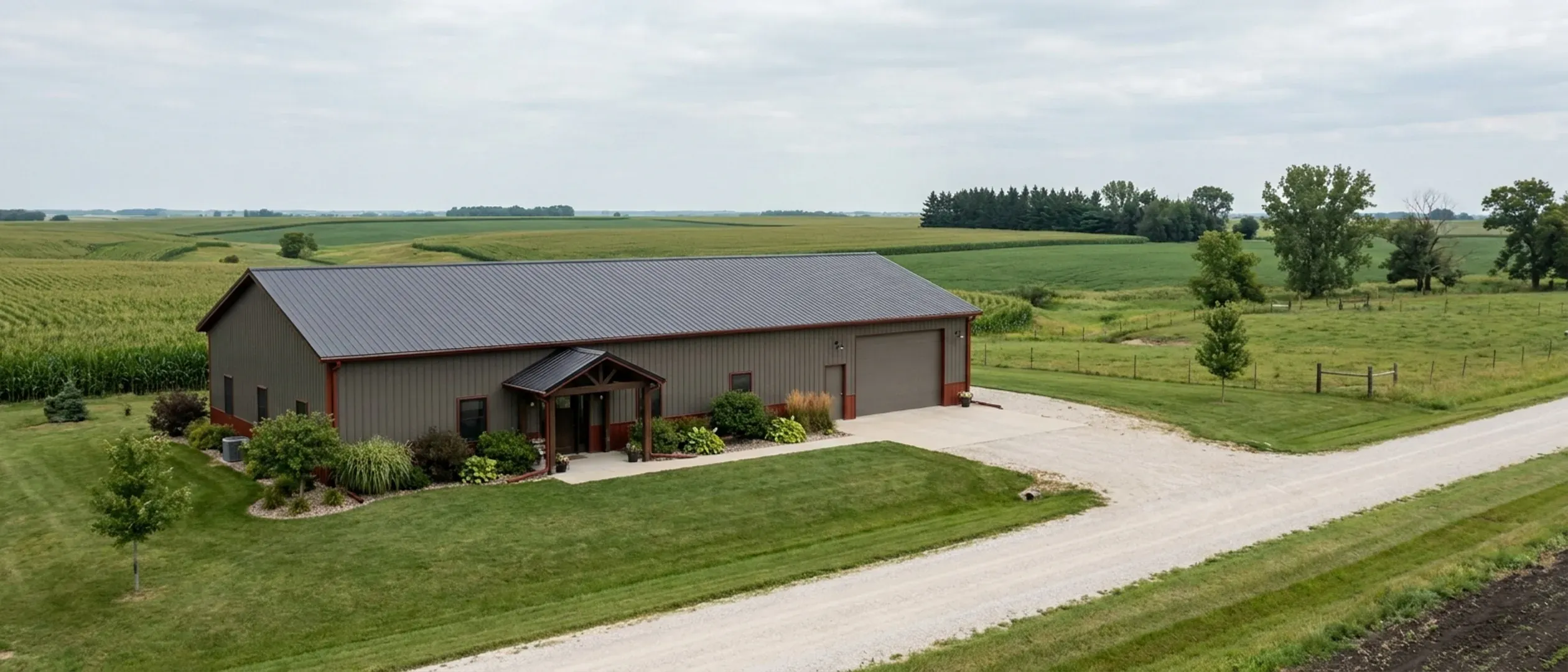
Barndominium vs. House Cost in Iowa: Which Is Cheaper to Build?
The honest answer to "is a barndominium cheaper than a house" is that it depends on which part of the budget you are looking at. A barndominium changes the structure and the skin of the building. It does not change the kitchen, the bathrooms, the wiring, the furnace, the foundation below the frost line, or the well and septic system on a rural Iowa lot. NAHB's national survey of what builders spend puts numbers on each of those stages, and the Census Bureau measures what custom homes cost per square foot in the Midwest. Put together, they show where a barndominium can save money, where it cannot, and where Iowa's own rules treat both building types exactly alike.
Figures on this page are cited third-party or government data, not a quote from Iowa Barndominium Builders.
Bottom Line Up Front
- The shell is the only part a barndominium changes. NAHB's 2024 survey puts framing at 16.6% and exterior finishes at 13.4% of construction cost, about 30% combined; the rest of the house costs the same whatever holds up the roof.
- Interior finishes (24.1%) and plumbing, electrical and HVAC rough-ins (19.2%) are over 43% of construction cost in NAHB's survey. A barndominium with a conventional house's finish schedule will cost close to a conventional house.
- Iowa's statewide energy code, the sales tax on materials and the septic rules in 567 IAC chapter 69 apply to both building types in the same way, so they do not tilt the comparison.
What actually moves the number
Framing and skin
NAHB's 2024 survey puts framing (16.6%) and exterior finishes (13.4%) at about 30% of construction cost. This is where a post-frame or steel system and metal cladding compete with stud walls, sheathing and siding.
Systems and finishes
Interior finishes and major system rough-ins add up to more than 43% of construction cost in NAHB's figures. Cabinets, flooring, fixtures, wiring and HVAC are priced by the room and the fixture, not by the frame.
What is under it
Foundations are 10.5% of construction cost in NAHB's survey. The Census Bureau reports that 55% of contractor-built homes finished in the Midwest in 2025 had a full or partial basement; a barndominium on a slab skips that, while a barndominium with a basement does not.
How much you enclose
Clear-span framing makes it easy to enclose a lot of floor. Every square foot that gets heated and finished carries the interior and systems share of the budget, so a larger barndominium can cost more than a smaller conventional house even at a lower cost per foot.
Where a barndominium can cost less
The savings, when they exist, come from the structure and the envelope. They are real but they are a slice of the budget, not the whole of it.
Fewer, larger structural members
A post-frame or steel building carries the roof on posts or frames set far apart instead of on continuous stud walls. That changes the framing line, which NAHB's 2024 survey puts at 16.6% of construction cost, including trusses at 3.0% and sheathing at 1.5%.
Metal roofing and wall panels
Exterior finishes are 13.4% of construction cost in NAHB's figures, split across wall finish (5.7%), roofing (3.9%) and windows and doors (3.7%). Metal panels replace the first two; windows and doors stay the same.
Open plans need fewer interior walls
Because clear-span framing does not need interior bearing walls, an open plan can have fewer partitions to frame, drywall and trim. How much that saves depends entirely on the plan you choose.
Shop and living under one roof
If you would otherwise build a house and a separate shop, putting both under one roof shares a foundation, a roof and one set of exterior walls. An unheated shop bay also skips most of the interior-finish share of the budget.
Where it costs the same
Most of the money in a finished home goes into things a barndominium does not change.
Kitchens, baths and floors
NAHB puts cabinets and countertops at 4.5% of construction cost, flooring at 3.6%, appliances at 1.8% and plumbing fixtures at 1.9%. A barndominium kitchen with the same cabinets costs what a house kitchen with those cabinets costs.
Plumbing, wiring and HVAC
Plumbing (6.3%), electrical (6.4%) and HVAC (6.3%) together are almost a fifth of construction cost in NAHB's survey. Tall walls and open volumes can add to heating and cooling design in a barndominium rather than reduce it.
Foundation below the frost line
Every footing and post in Iowa goes below the frost depth your jurisdiction publishes, whatever the building. Under 481 IAC 301.8(3), the design values in Table R301.2 are set by the location of the project rather than statewide, so both building types face the same local figure.
Land, well, septic and drive
The land, the well, the septic system and the driveway are the same bill whatever you build on the site. Iowa State University's 2025 survey averages Iowa farmland at $11,549 an acre, and those costs sit outside any per-square-foot comparison.
What the Midwest numbers say about custom homes
A barndominium on rural land is almost always a one-off, contractor-built home on the owner's own lot. The Census Bureau measures that group separately from homes builders put up for sale.
Custom homes on your own land
For contractor-built homes started in the Midwest in 2025, the Census Bureau reports a median contract price of $194.09 per square foot and an average of $202.13, land excluded. This is the fair benchmark for a finished barndominium you contract to build.
Homes builders sell
New homes sold in the Midwest in 2025 had a median price of $155.19 per square foot, lot excluded, per the Census Bureau. Those are mostly production homes in subdivisions, where repetition keeps the cost per foot down.
Size is part of the difference
The median contractor-built home finished in the Midwest in 2025 had 2,289 square feet, per the Census Bureau. A barndominium plan that encloses much more than that will cost more in total even if its cost per foot is lower.
What this means for a comparison
Compare a barndominium quote with the custom, contractor-built figure, not with the price of a new house in a subdivision. Then compare it with a conventional custom quote on the same plan and the same finish schedule, because that is the only comparison that isolates the building type.
Resale and appraisal
The cheaper building is not the better deal if it appraises low or is hard to finance. This is where barndominiums carry a cost a conventional house does not.
Lenders treat unusual homes case by case
Fannie Mae's Selling Guide says loans on unique or nontraditional housing are eligible when the appraiser has adequate information to develop a reliable opinion of market value, and that both the appraiser and the underwriter decide that case by case. Where few similar homes have sold nearby, that judgment is harder.
Comparable sales do not need to match exactly
The same Fannie Mae section says it is not necessary for comparable sales to be of the same design as the home being appraised, though accuracy improves with the most similar sales available. In a county with few barndominium sales, expect the appraiser to use conventional homes and adjust.
A big shop can change how the property is read
Fannie Mae's guide says significant outbuildings, such as large barns or storage areas, may indicate that a property is agricultural in nature, and the lender must decide whether it is residential. A large attached shop is worth discussing with your lender before the plan is final.
Where a conventional house is the better value
On a city lot with sewer and water, among conventional houses, with no need for a shop, a conventional house is often the easier home to appraise, finance and sell. A barndominium earns its place where the shop, the open span or the rural site is the point.
Reading this because you are weighing a build? The next step is a plan drawn for your program.
What's different about Iowa
One energy code for both
Iowa Code § 103A.8A and 481 IAC 301.24 apply the 2012 International Energy Conservation Code, as Iowa amended it, to new residential construction throughout the state. A metal-clad barndominium and a sided house meet the same insulation requirements, whether or not your jurisdiction inspects.
The same sales tax treatment
The Iowa Department of Revenue's contractors guide treats the contractor as the consumer of building materials on new construction: 6% state sales or use tax, plus a 1% local option tax where one applies, is paid on materials, and the labor is exempt. That is true of a steel kit and a lumber package alike.
The same septic rules
Iowa's 567 IAC chapter 69 sizes a septic system by bedrooms, at 150 gallons per bedroom per day, not by building type or floor area. A three-bedroom barndominium and a three-bedroom ranch need the same minimum 1,250-gallon tank. Chapter 69 was rewritten in 2025 with a delayed effective date, so confirm the sizing the county sanitarian applies to your permit.
The farm-house exemption does not care about the frame
Iowa Code § 335.2 exempts a farm house on a working farm from county zoning, and § 331.304(2)(b) keeps a county building code off it. The exemption turns on the farm use, which the county decides, not on whether the house is a barndominium.
Pros and cons, honestly
Pros
- The framing and exterior share of the budget, about 30% of construction cost in NAHB's survey, is where a steel or post-frame shell can compete.
- One roof and one foundation for living space and shop, instead of a house and a separate building.
- Clear spans allow open plans with fewer interior bearing walls.
- Metal roofing and wall panels replace shingles and siding.
Cons
- Interior finishes and mechanical systems, over 43% of construction cost, cost the same as in any house.
- Appraisal depends on comparable sales, which can be scarce for barndominiums in a given county.
- A large shop can make a lender look harder at whether the property is residential.
- Easy-to-enclose space tempts a bigger building, and every finished square foot carries full interior cost.
Is it cheaper to build a barndominium or a house in Iowa?
How much does it cost to build a house in Iowa?
Do barndominiums appraise lower than houses?
Does Iowa's energy code apply to barndominiums?
Is a barndominium cheaper if I need a shop anyway?
Are metal barndominiums cheaper to heat in Iowa?
Where does a barndominium not make financial sense?
Questions answered? Tell us what you want to build and we will put real numbers against it.
Sources
- NAHB — Cost of Constructing a Home 2024 — Table 1 construction cost breakdown by stage and component
- U.S. Census Bureau — Contract Price per Square Foot of New Contractor-Built Single-Family Houses Started — Midwest 2025: median $194.09, average $202.13
- U.S. Census Bureau — Price per Square Foot of Floor Area, New Single-Family Houses Sold — Midwest 2025: median $155.19
- U.S. Census Bureau — Square Feet of Floor Area in New Single-Family Houses Completed — Midwest contractor-built 2025: median 2,289 sq ft
- U.S. Census Bureau — Type of Foundation in New Single-Family Houses Completed
- Fannie Mae Selling Guide B4-1.3-05, Improvements Section of the Appraisal Report — Unique Housing Types; Properties with Outbuildings
- Iowa Administrative Code 481 chapter 301, State Building Code (PDF) — 301.8(3) Table R301.2 values by project location; 301.24 residential energy code
- Iowa Code chapter 103A, State Building Code (PDF)
- Iowa Administrative Code 567 chapter 69, Private Sewage Disposal Systems (PDF)
- Iowa Department of Revenue — Iowa Contractors Guide
- Iowa Code § 335.2 (PDF)
- Iowa Code § 331.304 (PDF)
- Iowa State University CARD — 2025 ISU Land Value Survey results
Keep reading
The pages that answer the next question this one raises.
What a barndominium costs in Iowa
The full cost picture: Census Midwest figures, land values by county and rural site costs.
Read itFinancing a barndominium in Iowa
Why the appraisal is the step to plan for, and which lenders finance barndominium builds.
Read itPost-frame homes
How a post-frame structure carries the building, and where it differs from stud framing.
Read itBarndominium floor plans with a shop
Where combining the house and the shop under one roof does its best work.
Read itWant a real number instead of a range?
Start the survey and tell us about your land and what you want to build. Include the county and parcel ID if you have them, because in Iowa the jurisdiction, the soil and the well and septic answers change the budget more than the building does. The survey costs nothing.