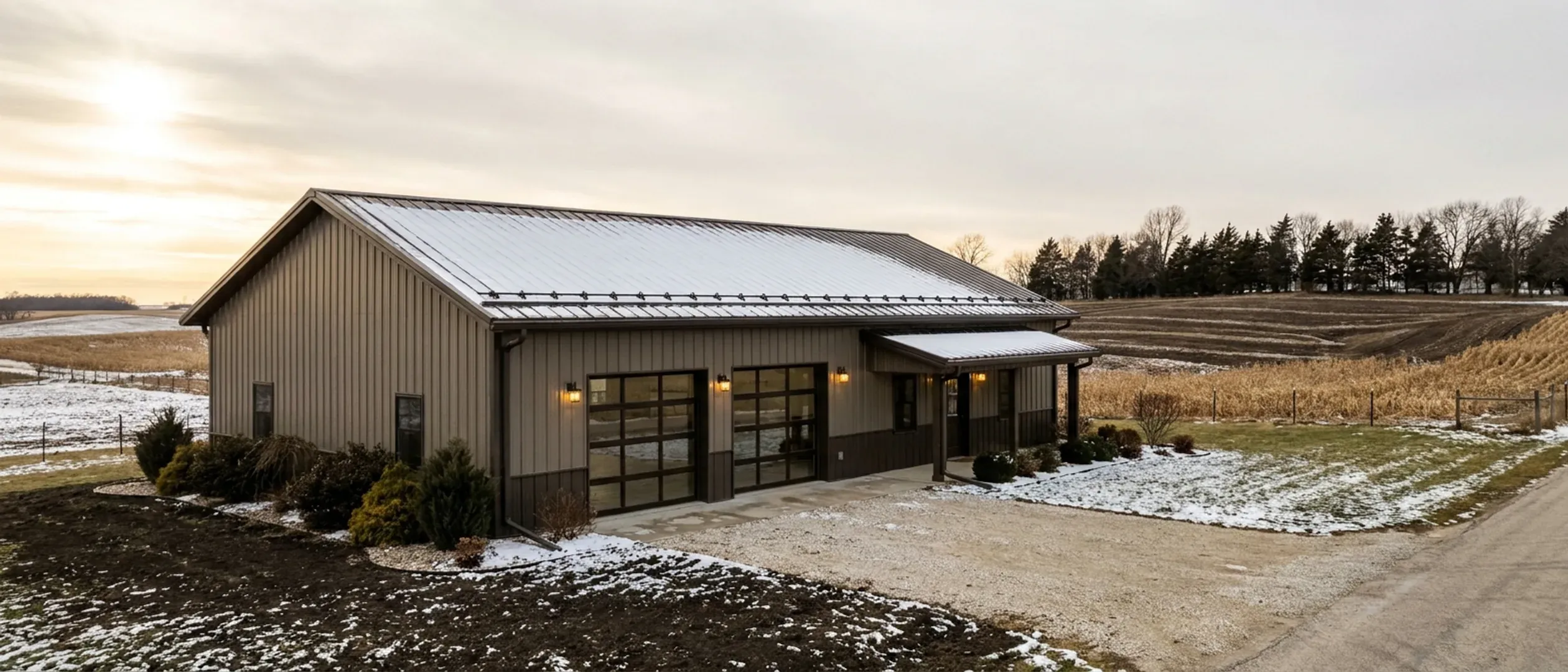
Are Barndominiums Worth It in Iowa? Land, Appraisal, Resale and the Shop-Plus-House Case
Whether a barndominium is worth it is not a question about the building type in general. It is a question about your land, your use of the shop, how long you intend to stay, and how the house will look to a lender and a buyer later. In Iowa each of those has a specific shape. Land is the largest single cost for many rural buyers, and the Iowa State University Land Value Survey measures it every year. Appraisals depend on comparable sales that rural Iowa often lacks. The rules that govern a sale — the time-of-transfer septic inspection in Iowa Code § 455B.172(11), the energy code that applies to every new home, the records a county with no building department never issues — decide how easy the house is to sell. This page sets out where the answer is clearly yes, where it is clearly no, and what to check in between. It does not quote a cost per square foot; the cost guide does that with sourced figures.
Figures on this page are cited third-party or government data, not a quote from Iowa Barndominium Builders.
Bottom Line Up Front
- Worth it when you genuinely need shop, equipment or storage space you would otherwise build separately, and you intend to stay long enough that resale variability stops mattering.
- Questionable on a short horizon, when you need the highest possible loan amount, or when the plan depends on a farm-house exemption from zoning that a county in Iowa may refuse.
- In Iowa the land usually decides the project. The Iowa State University survey puts average farmland at $11,549 per acre statewide in November 2025, so the acreage, its zoning and its soils deserve as much scrutiny as the building.
Where the answer is clearly yes
Each of these is a situation rather than a preference. If two or more describe you, a barndominium is very likely the right building.
You need a real shop, and would build one anyway
Equipment, vehicles, a trade, livestock gear or a workshop that would otherwise mean a house plus a separate outbuilding. One foundation, one roof and one envelope for both is the building type's strongest case, and it does not depend on any contested cost claim.
You own or are buying acreage and intend to stay
On a long horizon, appraisal gaps and a narrower buyer pool matter less, and the day-to-day use of the building matters more.
You want an open, adaptable plan
Clear spans mean interior walls can move later. For households expecting to change — children arriving or leaving, a parent moving in, a home business growing — that flexibility has real value.
You will pay for the envelope
A well-insulated, air-sealed, ventilated barndominium is a comfortable Iowa house. A cheaply insulated one is not, and the difference shows up in the first winter.
Where the answer is probably no
None of these rules a barndominium out, but each makes a conventional house, or a house plus a separate shop, the safer choice.
You expect to sell within a few years
A particular house-and-shop combination suits a narrower set of buyers, and appraisals are less predictable, so the exit is the weak point on a short horizon.
You need the largest possible loan
If the budget only works at maximum loan-to-value, an appraisal that comes in low can stop the project. Conventional construction appraises more predictably.
The lot is in a subdivision or a city
Covenants and city zoning often restrict metal exteriors, accessory building size or shop use. Read them before designing.
The plan depends on avoiding zoning
If the project only works because the house would be exempt as a farm house, confirm that with the county in writing first. Lang v. Linn County Board of Adjustment shows a county can refuse.
Questions that decide it for your land
Answer these before you buy land or order a building package.
Does the zoning allow a dwelling, and a building this size?
Minimum lot size, setbacks, accessory building limits and whether a shop may be built first. If the county has no zoning, confirm that too.
Will the soil take a septic system?
The county board of health issues the permit after a site evaluation and a percolation test or soil analysis. A poor result changes the system type and sometimes where the house can go.
Is the road gravel, and does it close in spring?
Iowa Code § 321.471 lets counties restrict heavy vehicles on thaw-damaged roads for up to ninety days a year, which affects both the build schedule and everyday access for deliveries.
What will the insurer and the lender say?
Get an insurance quote describing the structure, the shop use and any wood or fuel-burning heat, and talk to a lender about appraisal before you commit to a plan.
How long will you stay?
The longer the horizon, the stronger the case. On a short one, weigh the resale risks above honestly.
What a barndominium does not change
Some costs and obligations are the same whatever the structure, and they are often most of the budget.
Site work, septic and well
The driveway, pad, drainage, septic system and well cost the same for a barndominium as for any rural house, and each needs its own county permit.
Interior finishes and mechanicals
Kitchens, bathrooms, flooring, HVAC, plumbing and electrical are priced by what you choose, not by the frame behind the drywall. Licensed electricians and plumbers do that work in either case.
The energy code
Every new Iowa home is subject to the statewide residential energy code, so a barndominium cannot save money by skimping on the envelope without falling short of the standard.
Reading this because you are weighing a build? The next step is a plan drawn for your program.
What's different about Iowa
Land values vary almost threefold across Iowa counties
The 2025 Iowa State University Land Value Survey, the only annual county-level farmland value estimate for all 99 Iowa counties, reports a statewide average of $11,549 per acre as of 1 November 2025. District averages ran from $14,522 per acre in Northwest Iowa to $7,623 in South Central Iowa, and county estimates from $16,269 in O'Brien County to $6,679 in Appanoose County. The survey reports medium-quality land averaging $10,809 and low-quality land $7,580. A small building site split from a farm usually sells on different terms from cropland, but where land is expensive the argument for putting house, shop and storage under one roof on fewer acres gets stronger.
Appraisal is where the value question gets tested
A lender's appraiser values the house against recent nearby sales. In rural Iowa there are often few sales of post-frame or steel homes, so the appraiser may work from conventional houses and adjust, and a large shop may be valued as an outbuilding rather than as living space. The result can be an appraisal below what the build cost, which limits the loan. Bring the plans, specifications and any local barndominium sales you can find to the lender before you commit, and read the financing guide for how construction draws interact with this.
The energy code protects value even where nobody inspects
Iowa Code § 103A.10(4) and 481 IAC 301.24 apply the 2012 IECC residential provisions, as amended by Iowa, to new homes throughout the state, including in counties with no building department. Building to that standard costs something up front, but it is the benchmark a buyer's inspector, an appraiser and a lender will use, and on a metal-skinned building it is also what keeps condensation out of the walls. A barndominium that meets it is easier to sell than one that relies on nobody having checked.
The septic system is inspected every time the house sells
Under Iowa Code § 455B.172(11), a private sewage disposal system serving a building must be inspected by a certified inspector before any transfer of ownership, and the county recorder will not record the deed until the report is provided or the buyer signs a binding agreement with the county board of health to have it done. A system installed under a county permit, with its as-built drawing on file, passes that step cleanly. It is one more reason to build the septic properly the first time.
A missing certificate of occupancy is a resale question, not a legal one
Where a county has no building department there is no certificate of occupancy to hand a buyer; Iowa Code § 103A.19(2)(d) makes certificates something a governmental subdivision issues where its ordinance requires them. That is lawful, but a buyer's lender may ask what stands in for it. The records you can produce — the septic permit and final inspection, the well permit, the electrical inspection Iowa Code § 103.23 requires for a new service, and energy-code documentation — are worth keeping in one file from the first day.
The farm-house exemption rarely changes the answer
Iowa Code § 335.2 keeps county zoning off a farm house primarily adapted for agricultural use, while so used, but the Iowa Supreme Court in Lang v. Linn County Board of Adjustment (2013) upheld a county that refused the exemption where farming was a sideline to the residence. If the value of the project depends on building something zoning would otherwise forbid, treat that as a reason for caution, not a plan.
Pros and cons, honestly
Pros
- The shop-plus-house consolidation is a genuine saving — one foundation, one roof and one envelope instead of a house plus an outbuilding — when you need the shop.
- Where Iowa farmland is expensive, putting house, shop and storage under one roof can make a smaller acreage work.
- Clear spans give a plan that can change with the household.
- A fast shell that can be closed in before winter keeps the interior schedule moving.
- Metal roofing and siding shed snow and resist rot with little maintenance.
- Building to Iowa's statewide energy code gives a documented standard a buyer and lender can rely on.
Cons
- Appraisals are less predictable in rural Iowa, where post-frame and steel home sales are few, and a large shop may be valued as an outbuilding.
- A narrower buyer pool for a particular house-and-shop combination makes the exit the weak point on a short horizon.
- Insurance classification differs between carriers, and a shop under the same roof raises questions to answer up front.
- Condensation and heating costs punish a cheap envelope through an Iowa winter.
- In counties with no building department there is no certificate of occupancy, so you must keep your own records for resale.
- The farm-house zoning exemption is often assumed and often refused.
- Site work, septic, well and interior finishes cost the same as for any house, so the structural savings are a smaller share of the total than many expect.
Are barndominiums worth it in Iowa?
Do barndominiums hold their value in Iowa?
Is land expensive for a barndominium in Iowa?
Will a bank lend on a barndominium in Iowa?
Is a barndominium cheaper than a regular house?
What happens at sale if my barndominium has a septic system?
Can I save money by building where there are no building codes?
Who should not build a barndominium?
Questions answered? Tell us what you want to build and we will put real numbers against it.
Sources
- Iowa State University — 2025 Land Value Survey: Overview (Working Paper 25-WP 674)
- Iowa Code § 455B.172 — private sewage and water; time-of-transfer inspection
- Iowa Code chapter 103A — State Building Code (§§ 103A.10, 103A.19)
- 481 IAC chapter 301 — residential energy code (301.24)
- Iowa Code § 335.2 — farms exempt from county zoning
- Lang v. Linn County Board of Adjustment, Iowa Supreme Court No. 11–0683 (29 March 2013)
- Iowa Code chapter 103 — electrical inspection (§ 103.23)
- Iowa Code § 321.471 — local weight restrictions on roads
- 567 IAC chapter 69 — private sewage disposal systems
Keep reading
The pages that answer the next question this one raises.
Barndominium pros and cons
The structural comparison behind this page: tornadoes, snow, condensation and the energy code in Iowa.
Read itBarndominium cost
Third-party cost figures for building a barndominium, with sources.
Read itBarndominium financing
Construction loans, appraisal and what lenders want to see.
Read itAre barndominiums legal in Iowa?
Zoning, the farm-house exemption, septic, wells and the statewide energy code.
Read itShouses
The shop-plus-house layout that makes the strongest case for this building type.
Read itTell us about your land
Start the survey and we will help you work through these questions for your parcel.
Read itWant a real number instead of a range?
Start the survey and tell us about your land and what you want to build. Include the county and parcel ID if you have them, because in Iowa the jurisdiction, the soil and the well and septic answers change the budget more than the building does. The survey costs nothing.