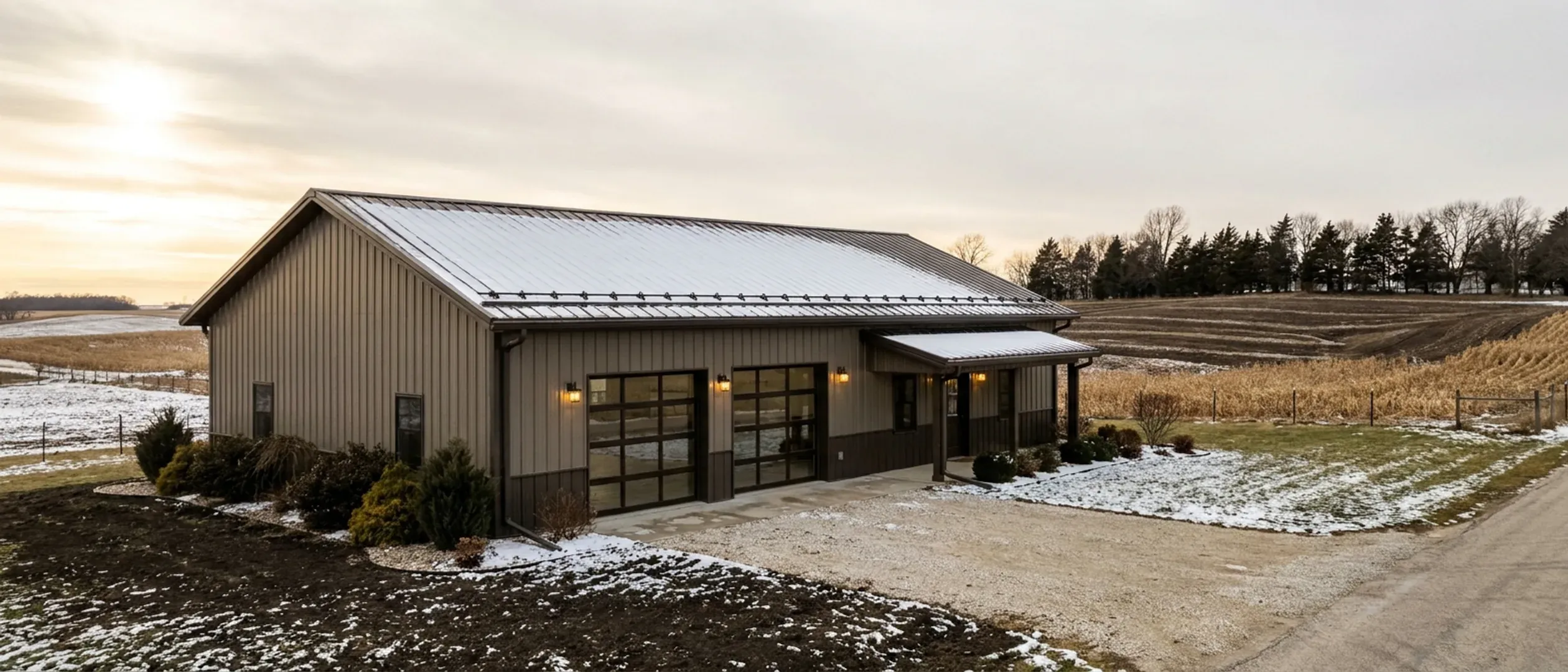
Barndominium Pros and Cons in Iowa: Wind, Snow, Winters, Appraisals and the Rules
Barndominium pros-and-cons lists tend to be written for everywhere at once, which means they are true nowhere in particular. This one is written for Iowa. Some of the advantages are structural and hold anywhere — clear spans, a shop and a home under one roof, a fast shell. Others depend on Iowa conditions: a residential energy code that reaches every new home in the state, a tornado record the National Weather Service has counted county by county, snow and frost values that each jurisdiction sets for itself, and a rural land market the Iowa State University Land Value Survey tracks every year. The disadvantages are equally specific — condensation behind a metal skin through a long heating season, appraisals with few local comparable sales, and a farm-house zoning exemption that many owners assume they have and do not. Each point below says where it comes from.
Figures on this page are cited third-party or government data, not a quote from Iowa Barndominium Builders.
Bottom Line Up Front
- The real structural advantage is the clear-span shell: no interior bearing walls, a plan you can change later, and a shop and a house under one roof and one foundation.
- The characteristic weakness in Iowa is moisture. A metal roof and walls over a heated interior through a long winter will condense unless the insulation, vapor control and air sealing are designed together — and Iowa's statewide residential energy code, 2012 IECC under 481 IAC 301.24, applies to that envelope whether or not anyone inspects it.
- The financial risks sit at the exit, not the build: few comparable sales for appraisal, a narrower buyer pool for a particular house-and-shop combination, and insurance classification that differs between carriers.
Three different buildings, one word
Before any advantage or disadvantage means anything, be clear which of these you are actually considering. The differences are structural.
Post-frame (pole barn) construction
Laminated or solid wood posts set in the ground or on concrete piers or brackets, carrying trusses and purlins, with girts on the walls and metal sheeting outside. The dominant farm-building method in Iowa and the most common barndominium shell. Its strengths are span and speed; its details to watch are the post-to-ground connection and moisture at the base of the posts.
Steel-frame construction
Rigid steel frames on a concrete foundation, with purlins and girts and metal panels. Longer clear spans are practical, and there is no wood in the primary structure; the frames bring thermal bridging that the insulation design has to handle.
Conventional framing with barn styling
A stick-built or panelised house dressed with metal siding, a gambrel or gable roof and a large door. It inspects, appraises and insures like an ordinary house, and gives up most of the structural advantages of the other two.
The advantages, and what they depend on
Each of these is real, but each has a condition attached.
Clear spans and a flexible plan
With no interior bearing walls the layout is not fixed by structure, so rooms can be rearranged later — provided the mechanical runs and plumbing stacks are planned with that in mind.
A shop and a house under one roof
One foundation, one roof and one envelope instead of a house plus a separate outbuilding. The saving is real if you genuinely need the shop; it is an expense if you do not.
A fast shell
Once the foundation is ready, the structure goes up and dries in quickly, which helps a build beat an Iowa freeze-up.
Durable exterior
Metal roof and wall panels resist rot and shed snow, and the finish carries a manufacturer's warranty. Hail can dent them; ask how a policy treats cosmetic damage.
Design freedom without a licensed architect
Iowa Code § 544A.18 lets people who are not licensed architects plan and design detached residential buildings of not more than three stories and their outbuildings, and buildings used primarily for agriculture. The structural design of the building package is still engineered, and a building department may require it stamped.
The disadvantages, and how to manage them
None of these is a reason to rule out a barndominium. Each is a reason to design carefully.
Condensation behind the metal skin
Warm, moist indoor air meeting cold steel through an Iowa winter is the characteristic failure of this building type. It is preventable with continuous insulation or closed-cell spray foam at the roof and walls, a deliberate vapor control strategy, air sealing and mechanical ventilation, designed together rather than chosen piece by piece.
Heating a tall volume
Heating a high-ceilinged shop with the living space costs more than heating the living space alone, and past one hundred thousand cubic feet of heated volume Iowa Code § 103A.19(3) requires a sealed energy review by a licensed architect or engineer. Separating the shop thermally from the house, or heating it only when used, avoids both.
Appraisals with few comparables
An appraiser needs recent nearby sales of similar homes. In much of rural Iowa there are few post-frame or steel homes to compare against, so values can come in low or be adjusted from conventional houses. The financing guide explains how to prepare.
Insurance classification
Carriers rate post-frame and steel homes differently from one another and from conventional framing, and a shop under the same roof raises questions about what is stored and worked on there. Get quotes before you commit to a plan.
Resale to a narrower market
A house-and-shop combination suits some buyers exactly and others not at all. On a short ownership horizon that narrower pool is a real risk.
Less oversight in no-code counties
Where no building department exists, nobody inspects the foundation or framing. That saves time and fees but puts the whole burden of quality on the designer, the builder and the owner.
Who a barndominium suits in Iowa — and who it does not
The same building is a good decision for one household and a poor one for the next.
Usually a good fit
Owners who need real shop, equipment or storage space; who are building on their own acreage and plan to stay; and who will pay for a properly designed envelope rather than the cheapest insulation package.
Worth thinking twice
Buyers expecting to sell within a few years, those who need the highest possible loan-to-value on a construction loan, and anyone relying on the farm-house exemption to avoid zoning or permits on an acreage.
Check before you buy the land
Whether the zoning allows a dwelling, whether soils will take a septic system, and whether the road to the site is gravel subject to spring weight embargoes.
Reading this because you are weighing a build? The next step is a plan drawn for your program.
What's different about Iowa
Tornadoes: frequent in Iowa, and mostly weak
The National Weather Service office at Johnston prepared an Iowa tornado climatology from Storm Data reports for 1980 to 2019. It counts 1,928 tornadoes in Iowa over those forty years, an average of around 48 a year, and reports that 87 percent were rated EF0 or EF1, with the remaining 13 percent rated EF2 through EF5. That shape matters for a building decision. No ordinary house of any construction is designed to survive a direct hit from a violent tornado, but the weak end of the scale — where most Iowa tornadoes sit — is where connection details decide what stays on. For a post-frame or steel barndominium that means embedded or anchored posts and columns, engineered truss-to-post and rafter connections, and roof and wall sheeting fastened to the schedule the engineer specifies. Many owners also add an interior storm room, designed and anchored as its own engineered element rather than as an ordinary closet.
Snow load and frost depth are set where you build
The Iowa State Building Code does not publish a single snow load or frost depth for the state. 481 IAC 301.8(3) says the values in the IRC's climatic and geographic design table are determined by the location of the project, so each city or county that runs a building department publishes its own, and elsewhere the engineer of the building package sets them. On a post-frame building those two numbers decide the depth of every post hole or pier and the spacing and size of trusses and purlins. A wide clear-span roof is efficient, but it has to be designed for drifting against a taller section or a lean-to, which is exactly where barndominium roofs change height.
The energy code applies to every new Iowa home
Iowa Code § 103A.10(4) applies the state code's thermal efficiency standards to all construction in the state containing heated or cooled space, and 481 IAC 301.24 adopts the 2012 IECC residential provisions, as amended by Iowa, throughout the state. In a county with no building department there is no one to inspect it, but the standard still applies — and it is the standard an appraiser, buyer or lender will judge the house against. For a metal-skinned building that is a benefit: designing to it forces the insulation and air-sealing decisions that also prevent condensation.
Farmland is expensive, and the land often decides the project
The 2025 Iowa State University Land Value Survey puts the statewide average value of Iowa farmland at $11,549 per acre as of 1 November 2025, with Northwest Iowa the highest district average at $14,522 per acre and South Central Iowa the lowest at $7,623. The survey's county estimates run from $16,269 per acre in O'Brien County to $6,679 in Appanoose County, and its authors cite limited land supply among the factors supporting the market. Those are averages for agricultural land, not for a building site, and a small acreage split from a farm often sells on different terms — but they explain why many Iowa barndominium buyers look for a few acres rather than a farm, and why the zoning status of a small split matters so much.
The farm-house exemption is narrower than many owners expect
Iowa Code § 335.2 exempts farm houses and farm buildings from county zoning while they are primarily adapted for agricultural use, and § 331.304(2)(b) keeps a county building code off them. But the Iowa Supreme Court, in Lang v. Linn County Board of Adjustment (No. 11–0683, 29 March 2013), upheld a county that denied the exemption where the farming was a sideline to the residence, saying the county could weigh the size, value and construction date of the house against the scope, value and duration of the agriculture. A barndominium on an acreage is often exactly that fact pattern. Plan on zoning and, where it exists, the building code applying, and treat the exemption as something to confirm with the county rather than assume.
The records a buyer will ask for
Where no building department exists there is no certificate of occupancy. But an Iowa home still generates records: the septic construction permit and final inspection from the county board of health under 567 IAC chapter 69, the well construction permit under 567 IAC 49.3(3), and the electrical inspection that Iowa Code § 103.23 requires for a new single-family service. And when the house sells, Iowa Code § 455B.172(11) requires a certified inspection of the septic system before the deed can be recorded. Keeping those records complete is the cheapest thing you can do for resale.
Pros and cons, honestly
Pros
- Clear spans and no interior bearing walls: the floor plan is not fixed by structure and can be changed later.
- A shop, garage or equipment bay and a home under one roof and on one foundation instead of two buildings.
- A fast shell that can be closed in ahead of an Iowa winter so interior work continues through it.
- Metal roofing and siding that shed snow and resist rot, with manufacturers' finish warranties.
- Iowa lets people who are not licensed architects design detached homes of up to three stories, so plans can be adapted freely — with the structure engineered.
- The statewide energy code gives every new Iowa home, even in counties without inspection, a defined envelope standard to build to.
- In a jurisdiction with no building department, there is no structural plan review to wait for.
Cons
- Condensation behind a metal skin through a long Iowa heating season, unless insulation, vapor control, air sealing and ventilation are designed together.
- Heating a tall shop with the house costs more, and very large heated volumes trigger a sealed energy review under Iowa Code § 103A.19(3).
- Few rural comparable sales make appraisals less predictable and can limit loan amounts.
- Insurance classification and premiums differ between carriers for post-frame and steel homes.
- A narrower resale market for a particular house-and-shop combination.
- The farm-house exemption from county zoning is often assumed and often denied; Lang v. Linn County Board of Adjustment shows why.
- Where no building department exists, no one independently inspects the structure.
- Hail can dent metal panels, and a policy may treat cosmetic damage differently from functional damage.
Are barndominiums safe in Iowa tornadoes?
What snow load should an Iowa barndominium be designed for?
Do barndominiums have condensation problems in Iowa winters?
Is a barndominium cheaper than a house in Iowa?
Are barndominiums hard to finance or appraise in Iowa?
Can I avoid county zoning by building on farmland?
How long does a barndominium last?
Does Iowa's energy code apply to a barndominium in the country?
Questions answered? Tell us what you want to build and we will put real numbers against it.
Sources
- NOAA National Weather Service (Johnston, Iowa) — Iowa Tornado Climatology 1980–2019
- Iowa State University — 2025 Land Value Survey: Overview (Working Paper 25-WP 674)
- 481 IAC chapter 301 — State Building Code: 2024 IRC (301.8) and residential energy code (301.24)
- Iowa Code chapter 103A — State Building Code (§§ 103A.10, 103A.19)
- Iowa Code § 335.2 — farms exempt from county zoning
- Iowa Code § 331.304 — limits on county building codes
- Lang v. Linn County Board of Adjustment, Iowa Supreme Court No. 11–0683 (29 March 2013)
- Iowa Code chapter 544A — architects (§ 544A.18 exceptions)
- Iowa Code § 455B.172 — private sewage and water; time-of-transfer inspection
- Iowa Code chapter 103 — electrical inspection (§ 103.23)
Keep reading
The pages that answer the next question this one raises.
Are barndominiums worth it?
The decision page: resale, appraisal, land and the shop-plus-house case in Iowa.
Read itAre barndominiums legal in Iowa?
Zoning, the farm-house exemption, the statewide energy code, septic and wells.
Read itPost-frame homes
The most common barndominium structure in Iowa and how we approach the details that matter.
Read itSteel construction
When a steel frame makes more sense than post-frame, and what it changes.
Read itBarndominium financing
Appraisal and lender realities for post-frame and steel homes.
Read itTell us about your project
Start the survey and we will work through these trade-offs for your land and plans.
Read itWant a real number instead of a range?
Start the survey and tell us about your land and what you want to build. Include the county and parcel ID if you have them, because in Iowa the jurisdiction, the soil and the well and septic answers change the budget more than the building does. The survey costs nothing.